Usefull information
Everything you need to know about the Blue Ice Cave
How do Ice Caves form?
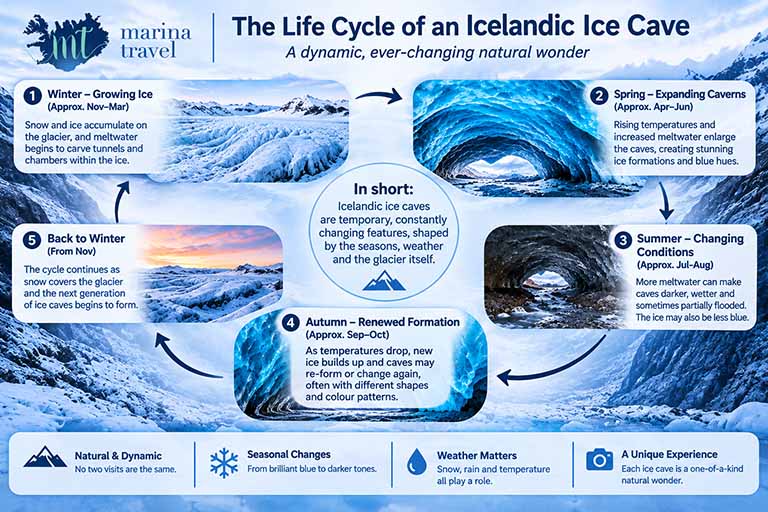
The Blue Ice Caves are formed naturally every winter through a fascinating combination of freezing, melting and the constant movement of the glacier. Unlike ordinary caves, which are carved into rock over thousands or even millions of years, glacier ice caves are constantly changing. No two winters are ever quite the same, and a cave that exists one year may look completely different, or disappear entirely, the next.
Like all glacier ice caves, their formation begins with crevices and cracks in the glacier. As temperatures rise during the warmer months, melting snow and glacial ice produce streams of water that find their way into these openings. The flowing water gradually widens the cracks, eroding and melting the surrounding ice. Because water can penetrate deep into the glacier, it can create channels and tunnels that continue to grow and change over time.
As the seasons change, the process becomes even more interesting. During winter, temperatures drop significantly, causing much of the meltwater to freeze again. However, not all the water freezes at once, and some continues to flow beneath or through the glacier. This constant cycle of freezing and thawing, combined with the natural movement of the glacier, shapes the tunnels and chambers into the incredible formations we see today.
But what makes the ice cave blue?
The answer lies in the way light interacts with the glacier ice, particularly through a process known as selective absorption and scattering of light.
Glacier ice is different from the ice we typically see in our everyday lives. Over hundreds, sometimes thousands, of years, layers of snow accumulate and become compressed under their own weight, gradually transforming into dense glacier ice. This process squeezes out most of the tiny air bubbles trapped between the snowflakes, leaving behind incredibly compact, clear ice.
When sunlight enters the glacier, it contains all the colours of the visible spectrum. However, as the light travels deeper through the ice, the longer wavelengths, such as red, orange and yellow, are absorbed more readily, while the shorter blue wavelengths are able to travel further before being absorbed. This selective absorption is what gives the ice its beautiful blue appearance.
The density and thickness of the ice also play an important role. The more compact and free of air bubbles the ice is, the less light is scattered back towards our eyes, allowing more of the blue wavelengths to travel through it. This is why the deepest, densest parts of a glacier often display the most intense shades of blue, ranging from pale turquoise to a rich, almost electric blue.
And blue isn’t the only colour nature can create inside these frozen caves! On certain occasions, ice can appear purple, red or even yellow. These unusual colours can result from a combination of lighting conditions, reflections from the surrounding landscape, mineral deposits, sediment, algae and other impurities trapped within the ice.
So, the next time you find yourself standing inside an ice cave, surrounded by glowing blue walls and ceilings, remember that you’re witnessing much more than just frozen water. You’re seeing thousands of years of compressed snow interacting with sunlight to create one of nature’s most extraordinary displays.
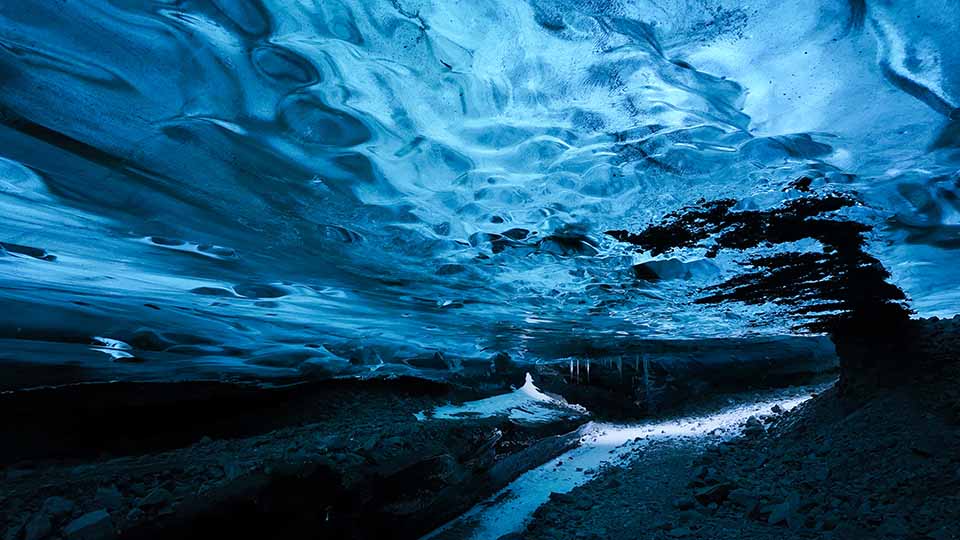
What makes the Blue Ice Cave so special?
What makes the Blue Ice Cave so special is not just its incredible beauty, but the fact that it is a natural phenomenon that changes from year to year. Unlike many other natural attractions, these caves are not permanent. They form naturally every winter, and there is absolutely no guarantee that the same cave will exist the following year.
At the beginning of each winter season, once temperatures have dropped and conditions become suitable, experienced glacier guides and experts venture onto the glacier to search for newly formed ice caves. They carefully explore the glacier, looking for openings, tunnels and chambers that have developed through the summer’s melting and winter’s freezing processes.
Every year brings a different discovery. Some winters, they find only small caves with narrow passages and limited space. In other years, the conditions are just right, and enormous chambers appear, with towering ice ceilings, winding tunnels and spectacular blue walls. The size, shape and colour of each cave depend on a combination of factors, including the amount of melting during the summer, the movement of the glacier, water flow and the temperatures throughout the year.
However, finding a cave does not automatically mean it can be opened to visitors. Safety is always the priority. Glaciers are constantly moving, and ice caves can be extremely unpredictable. The ceilings may become unstable, sections of ice can collapse, and melting water can weaken the surrounding structure. For this reason, glacier experts must carefully assess each cave before deciding whether it is safe enough for guided visits. Some caves, despite being incredibly beautiful, are simply too unstable or dangerous to enter.
And this is perhaps what makes the experience even more special: there is no guarantee that you will ever see the same cave again. A beautiful blue ice chamber that you visit this winter may have completely disappeared by next winter, replaced by an entirely different formation somewhere else on the glacier. Even the caves that return in a similar location will have changed shape, size and appearance.
So, if you ever have the opportunity to step inside one of these extraordinary natural formations, take it. You are not simply visiting an ice cave; you are witnessing a temporary masterpiece created by nature, one that may only exist for a single winter season.
You never know what the glacier will create next year, or whether the opportunity to see this particular wonder will ever come around again.